Raising Cane’s Franchise FDD, Profits & Costs
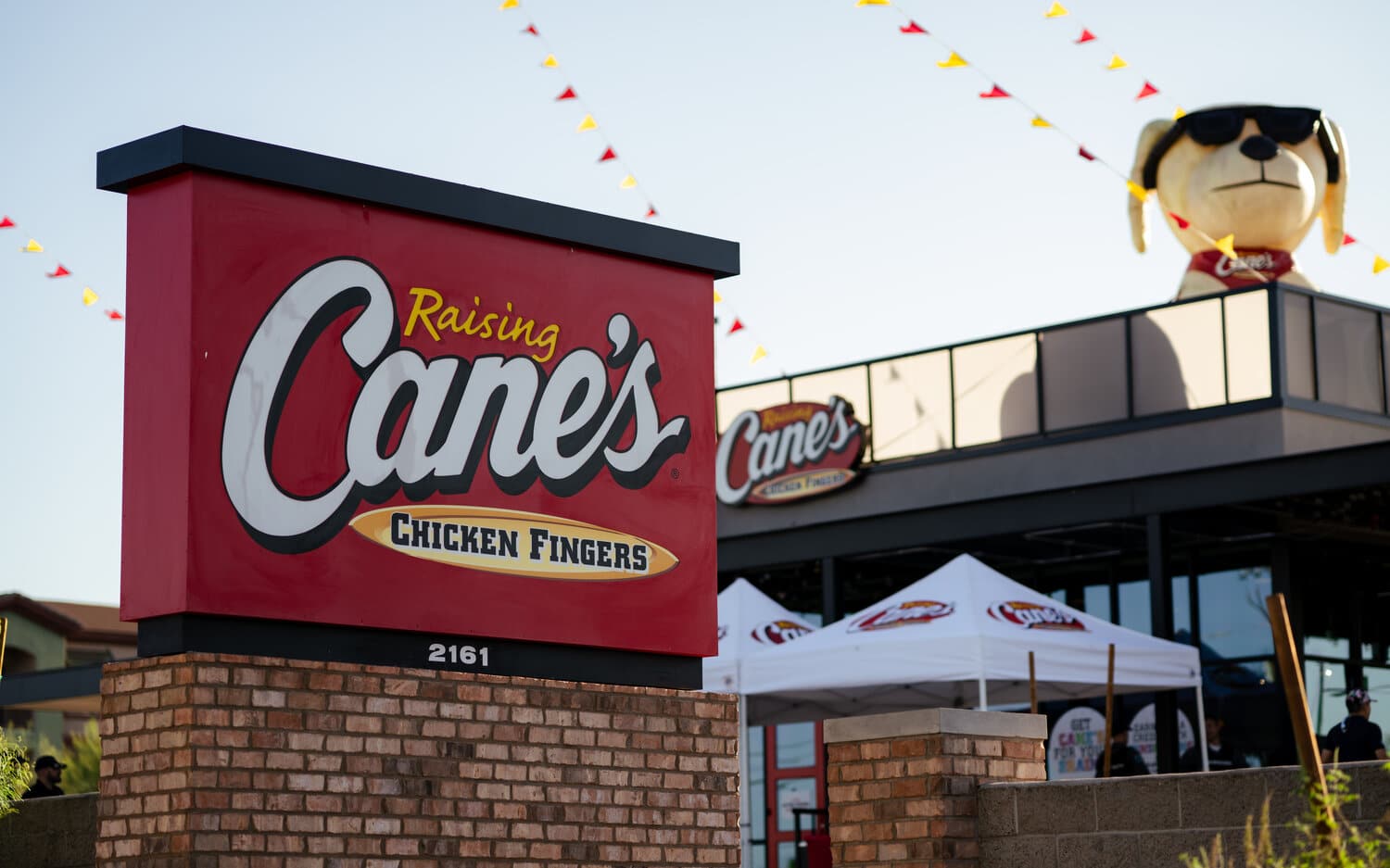
Raising Cane’s was founded by Todd Graves in 1996 in Baton Rouge, Louisiana, with the vision to focus on quality chicken finger meals as their “ONE LOVE®.” The company prides itself on its active community involvement, unique culture, and great crew.
With headquarters in Baton Rouge and an additional support office in Plano, Texas, the restaurant’s brand is recognized for its focus on providing craveable chicken finger meals and an enjoyable customer experience. The company’s vision is to grow globally while maintaining its commitment to quality and community.
Raising Cane’s started franchising in the same year it was founded, 1996. Today, the company has experienced rapid growth, boasting over 780 restaurants worldwide, with recent expansion into various states across the U.S. and internationally.
However, Raising Cane’s is currently not accepting new franchise applications in the U.S. as of now, focusing on company-owned growth instead. Raising Cane’s differentiates itself from competitors through its simple menu, emphasizing quality chicken finger meals, and its commitment to customer service and community engagement.
Initial Investment
How much does it cost to start a Raising Cane’s franchise? Raising Cane’s does not offer franchise opportunities, as all of its locations are company-owned.
Therefore, it is not possible to start a Raising Cane’s franchise, and there is no associated cost for franchising with the company.
For similar chicken food restaurant franchises, however, the initial investment is on average $1,163,000, ranging from $28,000 to $4,830,000.
Here are a few comparable franchises with their initial investment requirements:

Average Revenue (AUV)
How much revenue can you make with a Raising Cane’s franchise? Since Raising Cane’s does not franchise its stores and all locations are company-owned, Raising Cane’s does not publish a Franchise Disclosure Document. Therefore, it does not disclose the average revenue of its restaurants.
However, looking at comparable franchises, a similar chicken food restaurant franchise makes on average $1,662,000 in revenue (AUV) per year.
Below are 10 Raising Cane’s competitors and their average yearly revenue as a comparison:

Frequently Asked Questions
How much can a Raising Cane’s franchise owner expect to earn?
Since Raising Cane’s is entirely company-owned and does not operate as a franchise, there is no earning disclosure for a Raising Cane’s franchise.
Yet, let’s assume the average gross sales for a chicken-style restaurant franchise we gave earlier ($1,662,000 per restaurant). Assuming a 15% operating profit margin, $1,662,000 yearly revenue would result in $249,300 operating profit.
What funding options are available for a Raising Cane’s franchise?
Most franchise buyers in Raising Cane’s’s investment range finance their unit through an SBA 7(a) loan, with some multi-unit operators using SBA 504 loans for real estate. Buyers with rollable retirement funds sometimes use a ROBS structure to reduce debt service. See SharpSheets’ financial model hub for funding guidance.
How long does it take to pay back a Raising Cane’s franchise investment?
Payback periods for franchises in Raising Cane’s’s category typically run 3-7 years, depending on investment level, location performance, and financing structure. Actual payback varies significantly by unit performance and debt service obligations.
Who owns Raising Cane’s?
Raising Cane’s is owned by its founder, Todd Graves. He started the company in 1996 in Baton Rouge, Louisiana, and remains the owner, overseeing its operations and expansion. The company is privately owned and does not publicly trade its stock.
SharpSheets Editorial Team | sharpsheets.io | Last Updated: June 2026
→ How much does a Raising Cane’s franchise owner make? Full income breakdown, data tables, and payback analysis.
Disclaimer
Disclaimer: This content has been made for informational and educational purposes only. SharpSheets is an independent educational resource and is not affiliated with, endorsed by, or representing any franchisor mentioned on this website. Where noted, figures are taken from the franchisor’s Franchise Disclosure Document (FDD). In some cases, we may provide independent calculations or estimates based on publicly available information. We do not make any representation or warranties with respect to the accuracy, applicability, fitness, or completeness of the information presented in the article. You should not construe any such information or other material as legal, tax, investment, financial, or other professional advice. Nothing contained in this article constitutes a solicitation, recommendation, endorsement, advertisement, or offer to buy or sell any franchises, securities, or other financial instruments in this or in any other jurisdiction in which such solicitation or offer would be unlawful under the franchise and/or securities laws of such jurisdiction.
All content in this article is information of a general nature and does not address the detailed circumstances of any particular individual or entity. Nothing in the article constitutes professional and/or financial and/or legal advice, nor does any information in the article constitute a comprehensive or complete statement of the matters discussed or the law relating thereto. You alone assume the sole responsibility of evaluating the merits and risks associated with the use of any information or other content in this article before making any decisions based on such information or other content.
Research Raising Caness Costs Fees franchise data: For the full FDD cost breakdown, investment tables, and Item 19 disclosures, visit FranchisePayback.com → Raising Caness Costs Fees FDD Review.